Petroleum Products Division
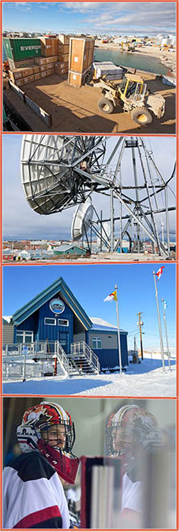
The Petroleum Products Division is responsible for the purchase, transportation (import), storage, and distribution of all Petroleum Products in Nunavut. In 2 communities (Iqaluit & Cambridge Bay), the distribution and inventory management has been outsourced, and in the remaining 25 locations PPD uses local contractors to provide the required services. Head Quarters is located in Rankin Inlet, with 3 regional offices in Rankin Inlet, Cambridge Bay and Pond Inlet.
OPERATIONAL OVERVIEW
What does the Petroleum Products Division do?
The PPD is responsible for performing the following functions:
- Annual bulk fuel resupply – The GN currently awards contracts for bulk purchasing and transportation of fuel products to communities.
- Bulk fuel storage – The GN owns all the bulk fuel storage tanks and dispensing facilities in each of the 27 communities served by PPD except Cambridge Bay, where the facilities are privately owned.
- Local delivery contracts – PPD awards and administers contracts with local businesses in each of the 27 communities to deliver fuel products to customers.
- Overhead and administration – PPD is responsible for all functions related to overhead and administration including: managing local delivery contracts; training local contractors; managing accounts (invoicing and accounts receivable); designing and maintaining data systems; conducting safety inspections; and controlling product quality and inventory.
- Policy and Planning – Although new operational strategies and policies require approval by Cabinet or the Financial Management Board (FMB) prior to implementation, PPD is responsible for monitoring and anticipating issues and events that may impact on the effectiveness of its operation. PPD is responsible to plan strategies and develop policies, for GN approval, that will mitigate negative events or ensure better value to the GN and customers.
What products does PPD provide?
PPD provides four primary fuel products as follows:
Gasoline is used primarily as a fuel for light vehicles snowmobiles and outboard engines.
Jet A-1 is certified for aircraft use and is supplied for turbine aircraft. This product may also be used for diesel and heating fuel purposes, thereby increasing flexibility in inventory management. Aviation gasoline is provided in only four communities throughout Nunavut. Most air traffic requires “Jet A-1” and there is minimal demand for Avgas. Due to the low demand for this product, there are no plans to extend the supply of aviation gasoline.
Diesel fuel which is the fuel most consumed in Nunavut has multiple uses. It is used for heating, motive (heavy equipment), aviation and production of electricity.
In addition to the four primary products, Naphtha is also supplied by the PPD. Because Naphtha is supplied in 3.78 litre containers, it is labour intensive and is highly subsidized by other fuel products to keep the price affordable.
How does the GN/PPD currently purchase fuel?
PPD has contracted Woodward’s Oil for the supply, marine transportation and delivery of all bulk refined petroleum products (Diesel, Gasoline, and Jet A-1) throughout the territory. These products are typically sourced from refineries in Saint John, Dartmouth, Montreal and Come-By-Chance. Winter grade Gasoline and Diesel are typically pre-purchased in March of each year and stored in bulk fuel facilities located in Lewisporte, Goose Bay or Long Pond before the summer shipping season. This policy provides enhanced fuel security and has resulted in significant savings to the GN.
How does GN set fuel prices?
The Financial Management Board has the authority to set retail prices in the communities served by PPD.
The retail price of fuel is based on the following cost components:
- Actual product cost;
- Actual transportation cost;
- Commissions for local fuel sales, dispensing and delivery services;
- Operations and maintenance expenses;
- Product evaporation/shrinkage; and
- Taxes (where applicable)
The sum of these components determines the base cost of fuel and is used to set the retail price in each community. In some communities the retail price is lower than the actual costs of providing the service. The difference is the level of subsidization that occurs between communities and fuel products. The intention is to set retail prices that are a fair value for the products and services in a particular community.
What is the Petroleum Products Revolving Fund (PPRF)?
PPD operates under the Petroleum Products Revolving Fund Act. The Act sets up the mechanism to purchase, transport, store, distribute, sell and supply refined petroleum products to residents in communities of Nunavut in a safe, economical, efficient and reliable basis.
Unlike most government operations, the expense of these activities is intended to be offset by revenues from the sale of the product. Thus, a financial mechanism is required to allow the PPD’s operating costs to be financed through the Petroleum Products Revolving Fund, which provides the financial resources to purchase and distribute the fuel consumed annually in Nunavut communities. The Revolving Fund operates similar to a commercial line of credit that is used by the private sector to finance account receivable and inventory.
The Fund provides working capital advances to finance inventory, accounts receivable, operating expenses and applicable taxes. The authorized limit of the Fund, which is the maximum amount by which the assets may exceed the liabilities, is $200 million. PPD is required by the PPRF Act to recover the advances from the Revolving Fund through retail sales.
The Petroleum Products Revolving Fund Act requires the PPRF to operate on a “break-even” basis. However, because of fluctuations in the profit and loss, the Petroleum Products Stabilization Fund was established so that the price of fuel did not have to be revised each year to accommodate the variances. The limit of the Petroleum Products Stabilization fund is ± $10 million, after which an appropriation is required. The Stabilization Fund accumulates the profits/losses in the PPRF. It is similar to the Retain Earning Account recorded in the financial statements used in the private sector.
What can be done to reduce cost pressures?
To avoid the uncertainty of volatile pricing caused by world market supply fluctuations, the GN can attempt to mitigate the higher cost by implementing a “hedging strategy”. The hedge allows the buyer to predetermine a market price he wants to pay for his fuel by buying financial instruments in the “futures” or “options” markets on the New York Mercantile Exchange (NYMEX)
There are numerous options available in the market place, and one needs the guidance of experienced market traders to tailor-make an appropriate option that suits a client’s financial standing. Basically we must attempt to predict what the cost of fuel will be on the market place during the GN delivery period of sealift re-supply July - October each year. We then take a risk by buying up front futures/options at the selected price, and when the delivery time arrives sell them at a gain, loss or breakeven value.
Contact Petroleum Products Division
P.O. Box 590
Rankin Inlet, NU
X0C 0G0
Fax: 867-645-3554
Phone: 867-645-8400
Email: scott.cooper@gov.nu.ca
|